
Dino Dimar
Dino Dimar is a Melbourne-based multidisciplinary visual artist with over two decades of experience navigating the rich intersections of culture, identity, and narrative. His practice is rooted in photojournalism and visual design — disciplines that have shaped a body of work defined by its depth, authenticity, and unflinching humanity.
As a former Art Director for prestigious print magazines and high-end coffee table publications, Dimar spent years crafting editorial narratives that moved beyond the surface — seeking the texture and tension beneath. This editorial sensibility remains central to his artistic vision, informing how he frames the world and the stories he chooses to tell.
His photographic work has reached international audiences through contributions to travel publications, where his lens captured the nuance and vitality of global cultures. His visual acuity extends into the moving image: Dimar has contributed to music video productions and served as a key contributor to Dayaw, a documentary that brought the stories of indigenous communities of the Philippines to wider cultural attention — a project that speaks to his enduring commitment to community and representation.
Collaborations with NGOs and fundraising platforms have further demonstrated Lara's belief that art carries civic responsibility. His practice is inseparable from his values — that visual storytelling, at its most powerful, affirms lives that might otherwise go unseen.
Now in Melbourne, finds himself at a deliberate threshold — absorbing a new environment, confronting new uncertainties, and seeking within that tension the singular affirmation that confirms an artist's continued faith in their own work. It is a journey both personal and universal: the ongoing negotiation between identity and belonging, between archive and emergence.
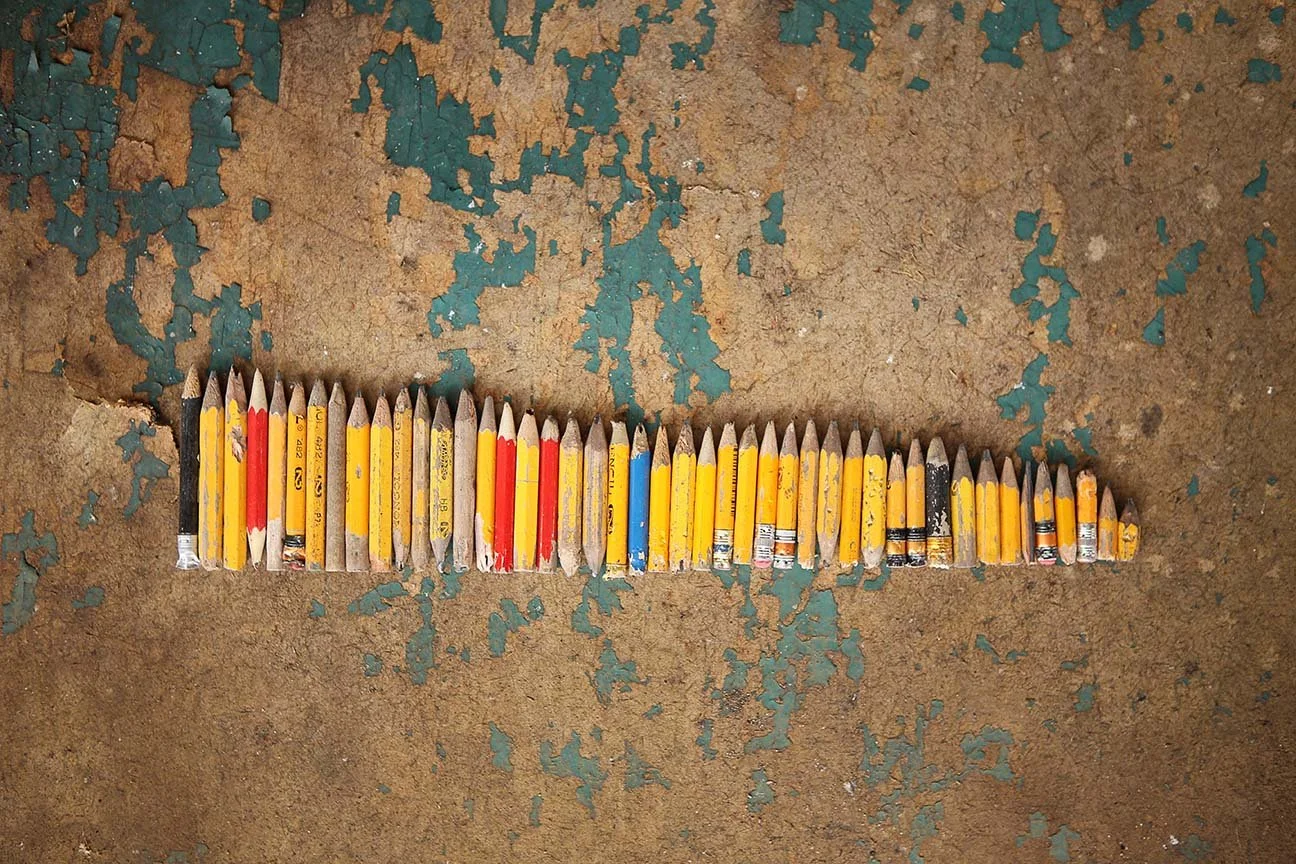
Dunong Hangang Dulo
Inkjet Print on Archival Matte paper, 2018
42 x 59.3cm
$6000 + GST (framed)
They will write until there is nothing left to hold. And when kindness finds its way across the mountain — hope is sharpened once more.
Somewhere in the far reaches of the Philippine archipelago, a child wakes before sunrise, crosses a river, climbs a mountain, or boards a small boat — not for adventure, but for the simple, defiant act of going to school. Before a single word is written, that child has already proven something the world rarely stops to witness: that the hunger to learn is stronger than any obstacle placed in its way.
A single pencil. Three, sometimes four children. One chance to write their name on a page — to say: I was here. I exist. I matter. Not with abundance. Not with ideal conditions. But with the quiet, radical act of sharing the last usable inch of graphite so that every hand in the room gets a turn to be known.
And when even the last fragment can no longer leave a mark — the messengers come. Crossing the same mountains, the same rivers, the same open seas the children cross every morning. Arriving at schools the world has overlooked, carrying new pencils, leaving with the worn ones. Received not as evidence of lack but as sacred proof — that here, children showed up, shared what little they had, and refused to disappear.
Beneath these pencils lies an old blackboard — chalk-dusted and full of memory. The teachers who stand before it were once these very children. When life gave them the chance to leave, some turned back. Not out of obligation, but out of love — pouring themselves into the next generation the way a pencil gives itself to the page. Completely. All the way to the end.
Dunong — wisdom — does not diminish as the pencil shortens. It concentrates. Hangang sa dulo — all the way to the tip — we ask only this: Don't let the pencil run out before the story is finished. Be the one who brings the next one.
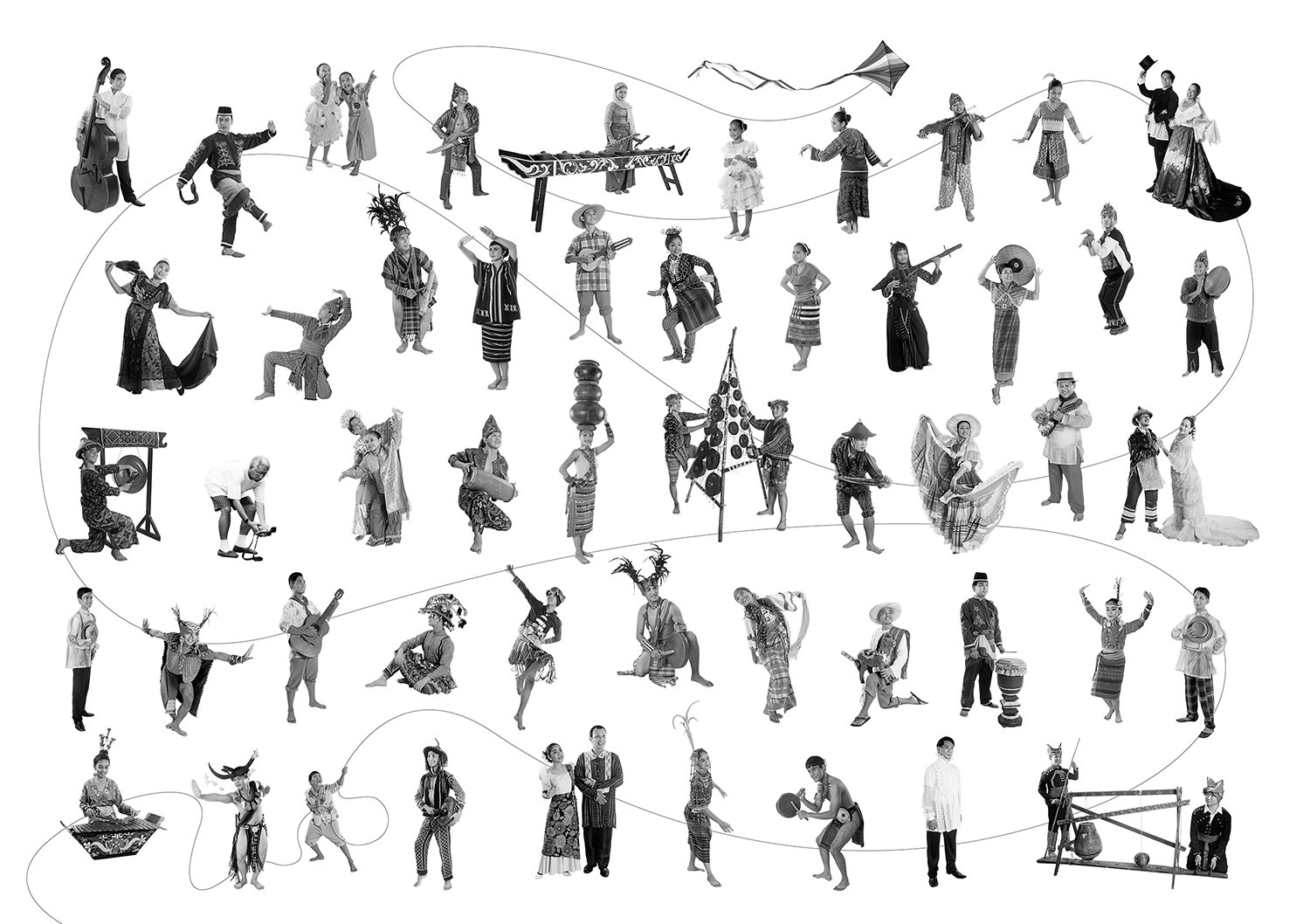
Ugat Ugnayan
Inkjet Print on Archival Matte paper, 2012
42 x 59.3cm
$6000 + GST (Framed)
Look closely, and you may recognize something. Not a face, perhaps — but a feeling. The particular way a body holds a tradition it did not choose but cannot release. Someone in this image may carry the bloodline of your own great-grandfather's tribe. Someone here may be moving the way your ancestors moved, on ground you have never stood on, in a language your body has almost forgotten.
Ugat. Root. The origin beneath the visible. Ugnayan. Connection. The thread that reaches across distance, generation, and forgetting.
An archipelago of more than 7,101 islands does not move as one. It breathes in hundreds of languages, in distinct rhythms, in ceremonies shaped by particular soil, sea, and sky. And yet across that scattered geography lives a shared inheritance — one that has survived colonisation, modernisation, and the slow erosion of memory. The Ramon Obusan Folkloric Group has spent decades refusing to let it disappear. Generation after generation of performers trained not to interpret these dances, but to carry them — preserving the exact posture, gesture, and traditional attire of each region in its purest form. In a country where so much has been diluted or lost, they remain the uncompromising keepers of the real.
And yet the image withholds something.
The color is gone. The hand-woven pigments, the regional distinctions sewn into fabric — all of it rendered into the same grey silence. What remains when the most visible markers of identity are stripped away? Everything else. The stance. The discipline. The pride that cannot be drained from a posture.
How do you dance in the age of EDM when your body remembers the Gansa of the Cordillera? When somewhere in you lives the Kulintang of Mindanao, or the movement of the Visayas — tied to a shore, a ceremony, a people? You do not choose between them. You carry both. And that tension — beautiful and unresolved — is not a problem to be solved. It is the dance itself.
This is not only a Filipino story. Across every culture, every nationality, every border drawn by history or politics, there are bodies that remember what the mind has been taught to forget. We are all, in some way, dancing between worlds — between who we were and who the modern age asks us to become. And perhaps that is not a burden. Perhaps that is the most human thing of all. That despite everything that separates us — language, distance, tradition — we still move. We still reach. We still find each other in the rhythm.
We may live differently. But we breathe as one.
Up to what point do we hide who we are?
Ugat Ugnayan answers not with words but with bodies — present, insistent, and undeniable even in black and white.